Reflections of the Brazilian Law in the Contemporaneity - vol III
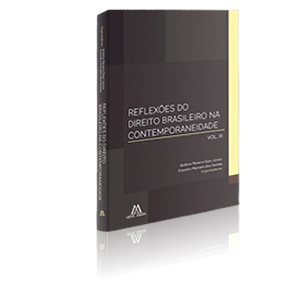 ORGANIZERS
Antônio Pereira Gaio Júnior
Evandro Marcelo dos Santos
Law, especially contemporary law, is in constant evolution, though not in a linear manner, as it is influenced by all the nuances present in the context of human life, whether social, political, or economic. In this path, it is essential to reflect on the challenges, but also on the possibilities that arise in the legal field, especially those that constitute the primary objective of this work, which is contemporary Brazilian law.
After all, it is through reflection that one critically perceives that a solid and humanized construction of law occurs through dialogue, with the Science of Law playing an essential role in strengthening the social fabric for which law is intended. The objective is to work in a practical yet fair manner on public policies being implemented, always seeking higher values directed toward the fundamental rights of citizens.
Following the dynamic evolution of society, especially in these times, is an enormous challenge for law in progress, without losing, along this path, the cherished essential values of a fraternal and egalitarian society, aspired to as the ultimate and greater mission.
For this very reason, the present work, now revealed to readers and entitled Reflections on Brazilian Law in Contemporary Times, was conceived by qualified professionals committed to legal knowledge, most of them professors from the Unis-MG Educational Group and from the Law programs of the Centro Universitário do Sul de Minas and Faculdade Três Pontas. These educators have spared no effort, and will continue to spare no effort, to think about the law of the future, bringing through their writings valuable contributions to the complex law of contemporary times.
The articles in this work, now in its third volume—demonstrating the strength of the project and the depth of its writings—bring readers a practical yet reflective and critical view of contemporary Brazilian law, with special attention to innovation, to the challenges, and to the advances (or even setbacks) of Brazilian law. Thus, it proves to be an absolutely indispensable work for all those who wish to reflect on the current stage in which Brazilian law finds itself and how it is inserted within the existing social fabric, as well as where it is heading.
Having said these brief words, it remains for us to wish that the articles now presented to readers may serve as inspiration and encouragement for the Science of Law to advance and become ever more assertive, always the result of deep reflection on the nuances and variables that contemporary law presents, making such reflections an open and increasingly explored path.